Top 3 Benefits of Continuous Insulation for Modern Building Projects
How Continuous Insulation Helps Meet Energy Codes and Improves Energy Efficiency
As with most industries, trends tend to come and go in construction. But one that started growing a decade ago and is now rapidly gaining steam is the use of continuous (or outbound) insulation.
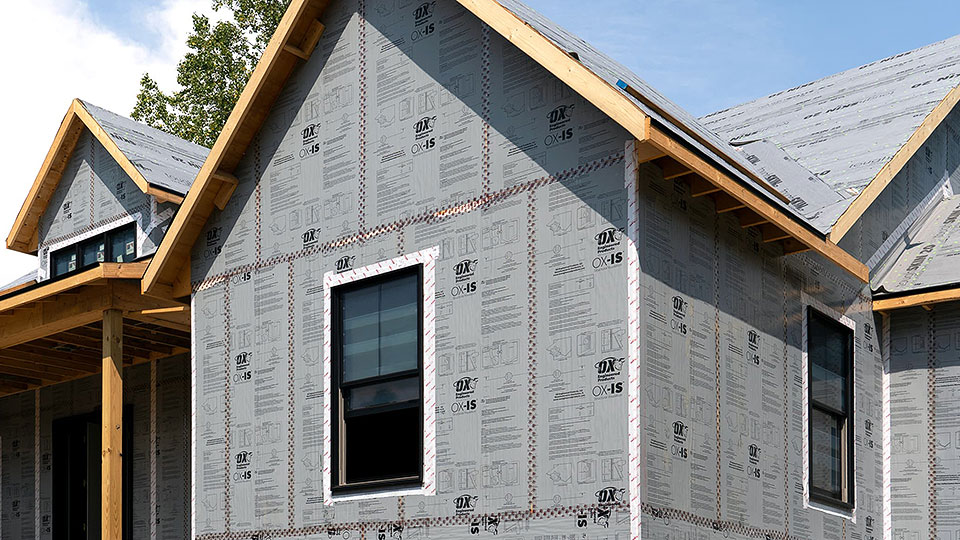
The American Society of Heating, Refrigerating and Air-conditioning Engineers formally defines continuous insulation (also known as outbound insulation) as “insulation that is continuous across all structural members without thermal bridges other than fasteners and service openings.” However, we find it easier to describe it as a building’s “coat.” When you zip up your coat before heading outdoors, that layer of protection keeps body heat in. But if you unzip that coat (or don’t put one on at all), you lose much of that warmth.
Because continuous insulation does the same thing for a building as a coat does for your body, it’s not surprising that customers who want to avoid wasting money and energy choose continuous insulation materials for their projects. What is surprising? The vast majority of people who choose continuous insulation are working on commercial projects, with few using it on residential ones. Residential customers and their builders can also benefit from putting “coats” on single-family and multifamily dwellings. In fact, these days, they have even more to gain. Here are the top three reasons you should be recommending continuous insulation for your residential projects:
1. Complies with energy codes today and tomorrow
Energy codes get updated every three years, and the most recent one (IECC 2024) has currently been adopted by 7 states, as has the previous one (IECC 2021). This code requires new builds in these states to have continuous insulation from climate zones 4-8 in the United States on wood frame structures.
Don’t live or work in one of these states? Don’t get lulled into a false sense of security. Codes are moving toward tighter energy standards that favor continuous insulation, and that requirement is expected to spread to the rest of the country sooner rather than later.
2. Pads your pocketbook with Inflation Reduction Act financial incentives
When the Inflation Reduction Act was signed into law in August 2022, it included a key incentive for builders to construct greener buildings.
The 45L tax credit, which has historically been a year-to-year program, was extended through 2032. Even better, new provisions were added to increase the federal tax credit:
- Single-family builders: Receive $2,500 per home when they meet the new energy standards – which require continuous insulation. If the home is built to Department of Energy (DOE) Zero Energy Ready Home program requirements, the tax credit goes up to $5,000 per house.
- Multifamily facility builders: Receive $500 per unit for meeting new energy standards and up to $1,000 per unit when certified by the DOE’s Zero Energy Ready Home program. (Builders who construct qualified multifamily homes may be eligible for a $5,000 per unit credit if they also meet prevailing wage requirements.)
The tax credit applies to every builder in every state, no matter the state’s code status. When the 45L tax credit was renewed on an annual basis, few builders took advantage of it because it was difficult to justify the added expense of materials and labor if the program was going to end. Now that it has a 10-year commitment, builders can plan more effectively and implement more of the credit requirements – such as continuous insulation.
When the 45L tax credit was renewed on an annual basis, few builders took advantage of it because it was difficult to justify the added expense of materials and labor if the program was going to end. Now that it has a 10-year commitment, builders can plan more effectively and implement more of the credit requirements – such as continuous insulation.
3. Helps your residential customers conserve energy – and money
You have probably heard the saying, “Build it right, build it tight.” That’s just a catchy way of saying that the best structures prevent air leakage and heat loss.
Continuous insulation goes a long way in creating an energy-efficient home. Homeowners who are initially reluctant to spend the extra dollars on continuous insulation may change their minds when they learn those extra inches of insulation save both energy and money. That’s especially good news to the increasing number of residential customers who want to minimize their impact on the environment and want the places they live in to be sustainably constructed.
If you’re ready to build more energy-efficient residential structures for your customers, contact the ABC Supply Interiors branch near you to learn about continuous insulation products and benefits.
The information provided is for general informational purposes only. All information provided is in good faith, and is not intended as a substitute for obtaining accounting, tax, legal, or financial advice from a professional accountant or lawyer. Any opinions expressed are those of the author. ABC Supply Interiors makes no warranties of any kind, express or implied, regarding, the accuracy, adequacy, validity, reliability, availability, or completeness of any information provided herein. Any questions regarding the information provided should be addressed to the author.

ABC Supply Interiors Opens Four New Locations
Doors open in Arizona, Illinois, Nebraska and Texas BELOIT, Wis. — October 6, 2026 — ABC Supply Interiors, formerly L&W Supply Corporation, a nationwide distributor of interior building materials and construction supplies, recently opened four new locations in Arizona, Illinois, Nebraska and Texas. The new branches expand ABC Supply Interiors’ ability to support contractors in […]

ABC Supply Announces CIO Leadership Transition
Tony Vaden to Retire as Chief Information Officer; Larry Sullivan Named Successor BELOIT, Wis. – October 6, 2026 – ABC Supply Co., Inc., the largest wholesale distributor of roofing, select exterior and interior building products, and outdoor solutions in North America, has announced that Chief Information Officer Tony Vaden will retire effective Jan. 1, 2027, […]